
Rethinking How We Evaluate Food
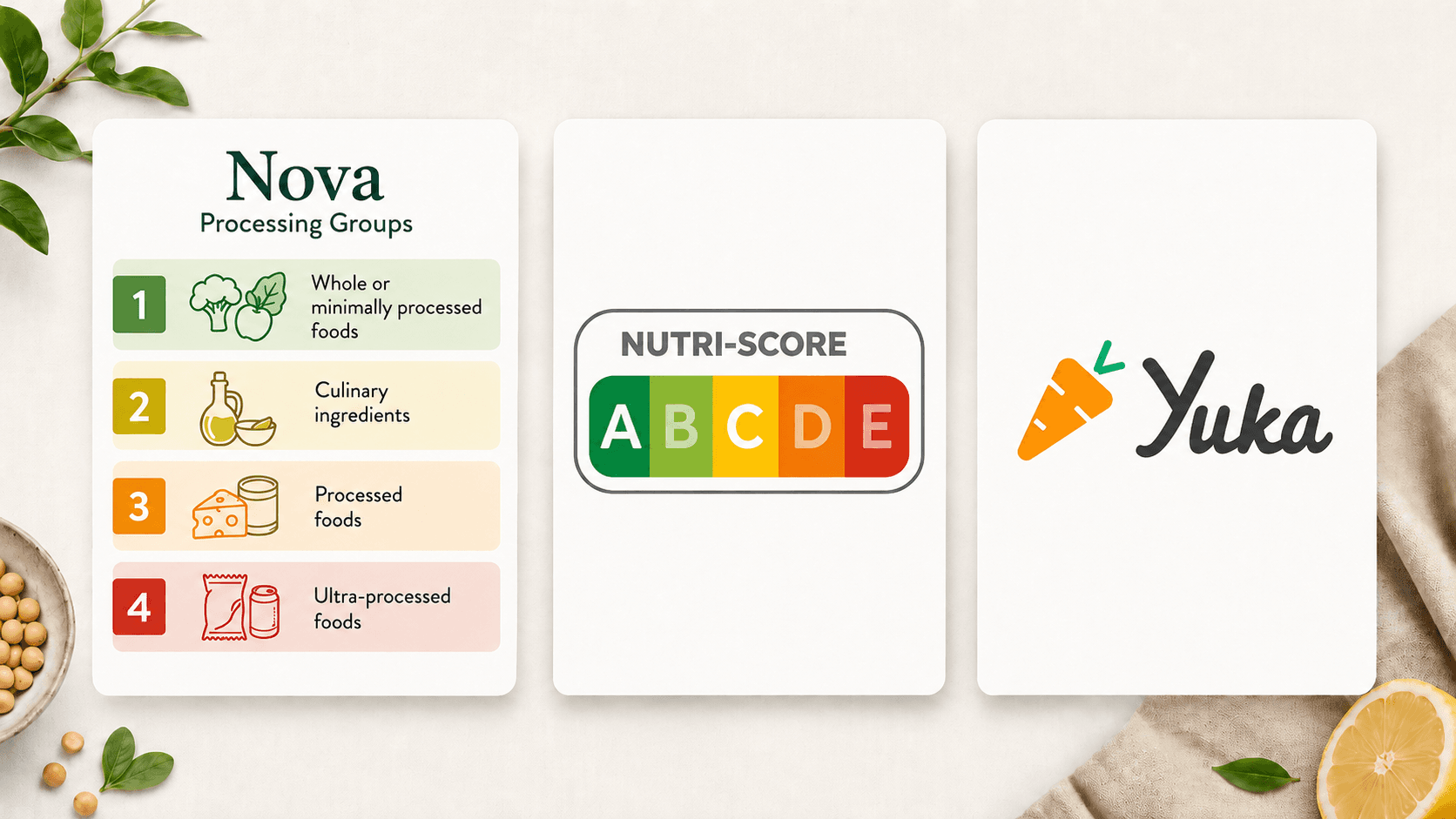
Why current systems fall short—and the case for a more integrated food rating model
Much of today’s nutrition discourse is increasingly centered on food processing. This shift is not without reason. Ultra-processed foods (UPFs) now make up a substantial share of modern diets—particularly in Western countries, where they account for more than half of total calorie intake in the United States [1]. At the same time, research continues to link diets high in UPFs with worse health outcomes [2].
But the growing emphasis on processing has created a deeper problem: it shifts attention away from what matters most—the nutritional value of food. Food is, above all else, sustenance. Any meaningful assessment should begin with its ability to meet physiological needs and its contribution to health. When processing becomes the dominant lens, it encourages narrow judgments about how healthfulness is defined.
At a broader level, existing approaches offer no clear or consistent way to define food quality. Instead, they rely on simplified classifications that obscure important differences, making it harder to assess what foods actually provide—especially when they do not fit neatly into conventional categories.
These limitations point to the need for a more coherent way of evaluating foods—one that better reflects their contribution to health.
When One Dimension Isn’t Enough
Concern about ultra-processed foods is increasingly being translated into simple behavioral signals, with labels like “non-UPF verified” beginning to appear [3]. This trend treats processing as a proxy for health—but this is both premature and misleading.
A key issue is the lack of scientific consensus. There is no single, consumer-ready definition of what constitutes “ultra-processed” or how it should guide dietary decisions [4, 5]. A 2025 systematic review identified multiple competing frameworks, each built on different criteria and assumptions [5]. As a result, an imprecise and inconsistently defined concept is being used to shape perceptions of health.
The problem goes beyond definitions. Processing is frequently treated as a uniform attribute, when in reality it refers to a wide range of transformations applied to foods [6]. These processes vary substantially in their effects: some preserve or enhance nutritional value, while others may diminish it. Consequently, foods classified as nutritionally favorable can still be ultra-processed, while less processed foods are not inherently superior [7].
More fundamentally, processing alone does not determine nutritional value. Nutritional composition and degree of processing represent distinct dimensions of food quality. While related, they do not consistently align, and neither can serve as a substitute for the other.
Relying on only one leads to incomplete—and often misleading—conclusions. A more accurate assessment requires integrating nutrition and processing [7]. Yet this remains rare in practice.
Different Models, Partial Views
Most existing systems reduce evaluation to a single dimension or combine signals without fully integrating them. Widely used frameworks such as Nova, Nutri-Score, and Yuka illustrate this.
Nova: Processing Without Nutritional Context
The Nova classification system, developed in Brazil and commonly used in nutrition research, categorizes foods based on the degree and purpose of processing [8]. It has been highly influential in shaping the modern focus on ultra-processed foods.
However, Nova was not designed to guide consumer decision-making. Even within academic literature, it is generally acknowledged to be too broad to function as practical dietary guidance [9]. The limitation is structural: Nova prioritizes processing over nutritional value, ignores dietary context, and groups nutritionally different foods into the same category. As a result, foods with very different health profiles can be treated as equivalent.
This becomes particularly visible in the classification of plant-based foods. Products such as fortified soy milk—often a meaningful source of protein and micronutrients—can be grouped alongside nutritionally poor ultra-processed products simply because they share a similar level of industrial processing.
Nova is therefore useful as a research tool for analyzing dietary patterns—but far less effective for answering the question that matters most to individuals: Is this food good for me?
Nutri-Score: Nutrition—But Not Neutral
If Nova emphasizes processing, Nutri-Score takes the opposite approach—focusing on nutritional composition while largely excluding how food is made [10].
Developed in France and now adopted across Europe, Nutri-Score assigns a simplified score based on key nutrients such as sugar, salt, fat, fiber, and protein. This makes it accessible and useful for quick comparisons—but that simplicity is built on a model with important limitations.
First, it evaluates nutrients in isolation, without accounting for processing. This allows highly processed products to receive favorable scores if they are reformulated to meet specific thresholds, regardless of ingredient quality.
Second, it evaluates foods per 100 grams—a standardized measure that does not reflect real consumption patterns, limiting its usefulness in everyday decision-making.
Third, category-specific rules introduce structural inconsistency. Products such as cheese are evaluated using different weighting systems, allowing them to benefit from tailored treatment rather than a unified standard.
But the most important limitation is deeper.
Nutri-Score is not a neutral representation of nutrition—it encodes assumptions about which nutrients matter and how they are recognized. In practice, this creates a structural bias that favors nutrients commonly associated with animal-based foods, while underrepresenting those more prevalent in plant-based foods.
For example, in products like cheese, protein can effectively function as a proxy for calcium, allowing these foods to receive credit without directly measuring calcium content. Plant-based foods are not afforded the same recognition—even when they are meaningful sources of calcium, such as tofu, legumes, or leafy greens.
At the same time, beneficial compounds more common in plant-based foods—such as polyphenols—are often excluded entirely. A 2026 study found that Nutri-Score can assign lower scores to products with higher cocoa content—despite their greater concentration of health-promoting bioactive compounds—because these compounds are not captured by the model [11].
The result is a system that appears objective, but systematically undervalues plant-based foods because of how nutritional value is defined.
Nutri-Score provides a useful starting point, but ongoing revisions to its scoring rules and category definitions make clear that it is still evolving and requires further improvement [12].
Yuka: Broader Signal, Same Limitations
Yuka, a popular consumer app, attempts to provide a more comprehensive health evaluation by combining Nutri-Score, additive risk assessments, and organic certification into a single score [13]. While this improves usability and suggests a more holistic model, that promise is misleading.
Because its nutritional foundation is built on Nutri-Score, Yuka inherits the same structural biases. The criteria it uses—and the assumptions behind them—carry through unchanged, including how different types of foods are implicitly favored or penalized.
Yuka also attempts to account for processing, but its approach is poorly executed. Processing is not evaluated directly. Instead, additives are used as a shortcut—flagged without assessing how processing affects nutritional integrity, such as changes to food structure or bioavailability. They are also assessed in isolation, without regard for dose, function, or dietary context.
Finally, Yuka incorporates an organic bonus into its scoring, despite limited evidence that organic foods offer a nutritional advantage over conventionally produced alternatives [14].
These limitations help explain why, despite driving reformulation, Yuka can produce unintuitive or misleading outcomes [14]. By combining multiple signals without resolving their underlying assumptions, it broadens the scope of evaluation without improving how food quality is actually assessed.
From Fragmentation to Misrepresentation
Across these systems, a consistent pattern emerges: evaluations do not fully reflect the role foods play in shaping health outcomes. Two recurring gaps help explain this pattern.
First, nutrition and processing are not meaningfully integrated. Models either treat them as separate dimensions or attempt to combine them in ways that remain superficial.
Second, current frameworks often anchor nutritional quality in animal-based foods, evaluating plant-based foods against this standard and thereby obscuring their contributions to health.
The result is not just a partial picture, but a tendency to misrepresent which foods actually support health.
This fragmentation is not limited to these three cases. A 2026 systematic review identified at least 25 methods for assessing food quality, with substantial variation in the definition of nutrition, the integration of dimensions, and the presentation of results — underscoring the absence of a shared standard for evaluating what food actually delivers [15, 16].
Food quality cannot be reduced to isolated dimensions or defined by skewed standards. It must instead be grounded in evidence and guided by objective criteria that reflect how foods actually contribute to health.
The Vegan Curator Food Review Model: An Integrated Approach
The Vegan Curator Food Review Model offers a more coherent framework for evaluating food quality. It starts from a simple principle: foods should be assessed based on what they deliver, in the context of how they are made and how they contribute to a healthy dietary pattern [17].
Rather than replacing existing approaches, our model the Vegan Curator Model builds on them, bringing nutritional assessment together with a more contextual understanding of processing, while avoiding the structural limitations that have led to the misrepresentation of certain foods.
Like Nutri-Score, it assesses nutritional value directly, based on meaningful contributions to health, such as fiber, protein, and essential micronutrients, balanced against components linked to adverse outcomes, including saturated fat, sodium, and added sugar. At the same time, it builds on insights from NOVA by evaluating processing in context, considering how and why a food is processed and how that process shapes its nutritional profile, rather than treating processing as a uniform signal.
Ingredient quality and structural integrity are assessed alongside these factors, including the nature of inputs, whole versus refined, and the extent to which original structure is preserved.
Crucially, these dimensions are evaluated together, capturing how nutrition, processing, and ingredients interact to shape food quality, influence health, and guide real-world decision-making.
The model is currently geared toward assessing plant-based foods, where the need for improved evaluation is most immediate, but can be readily extended to include animal-based foods.
Further detail on its structure and practical application is provided in a subsequent article.
Link to Article Part II → https://vegancurator.com/pages/inside-vc-food-review-model
References
[1] National Institutes of Health. Measuring ultra-processed foods in diet. (June 3, 2025); Accessed April 20, 2026. https://www.nih.gov/news-events/nih-research-matters/measuring-ultra-processed-foods-diet
[2] Lane, M. M., Gamage, E., Du, S., Ashtree, D. N., McGuinness, A. J., Gauci, S., Baker, P., Lawrence, M., Rebholz, C. M., Srour, B., Touvier, M., Jacka, F. N., O'Neil, A., Segasby, T., & Marx, W. (2024). Ultra-processed food exposure and adverse health outcomes: umbrella review of epidemiological meta-analyses. BMJ (Clinical research ed.), 384, e077310. https://doi.org/10.1136/bmj-2023-077310 and https://pubmed.ncbi.nlm.nih.gov/38418082/
[3] Zimmerman, Sarah. "Food and beverage brands adopt new non-ultraprocessed label." Food Dive, January 27, 2026. [Date Accessed: April 20, 2026]. https://www.fooddive.com/news/non-upf-verified-spindrift-amys-kitchen-ultraprocessed-foods/810607/
[4] Gibney MJ. "Ultra-Processed Foods: Definitions and Policy Issues." Current Developments in Nutrition (2019). Verified DOI link: https://doi.org/10.1093/cdn/nzy077 and https://pubmed.ncbi.nlm.nih.gov/30820487/
[5] Medin, A. C., Gulowsen, S. R., Groufh-Jacobsen, S., Berget, I., Grini, I. S., & Varela, P. (2025). Definitions of ultra-processed foods beyond NOVA: a systematic review and evaluation. Food & nutrition research, 69, 10.29219/fnr.v69.12217. https://doi.org/10.29219/fnr.v69.12217 and https://pmc.ncbi.nlm.nih.gov/articles/PMC12255158/
[6] Djurica, Gana. "Processed Food is a Spectrum (Not a Villain)." Vegan Curator, February 22, 2026. [Date Accessed: April 20, 2026]. https://vegancurator.com/blog/processed-food-is-a-spectrum
[7] Romero Ferreiro, C., Lora Pablos, D., & Gómez de la Cámara, A. (2021). Two Dimensions of Nutritional Value: Nutri-Score and NOVA. Nutrients, 13(8), 2783. https://doi.org/10.3390/nu13082783 and https://pubmed.ncbi.nlm.nih.gov/34444941/
[8] Monteiro, C. A., Cannon, G., Moubarac, J. C., Levy, R. B., Louzada, M. L. C., & Jaime, P. C. (2018). The UN Decade of Nutrition, the NOVA food classification and the trouble with ultra-processing. Public health nutrition, 21(1), 5–17. https://doi.org/10.1017/S1368980017000234 and https://pubmed.ncbi.nlm.nih.gov/28322183/
[9] Astrup, A., & Monteiro, C. A. (2022). Does the concept of "ultra-processed foods" help inform dietary guidelines, beyond conventional classification systems? NO. The American journal of clinical nutrition, 116(6), 1482–1488. https://doi.org/10.1093/ajcn/nqac123 and https://pubmed.ncbi.nlm.nih.gov/35670128/
[10] Merz, B., Temme, E., Alexiou, H., Beulens, J. W. J., Buyken, A. E., Bohn, T., Ducrot, P., Falquet, M. N., Solano, M. G., Haidar, H., Infanger, E., Kühnelt, C., Rodríguez-Artalejo, F., Sarda, B., Steenbergen, E., Vandevijvere, S., & Julia, C. (2024). Nutri-Score 2023 update. Nature food, 5(2), 102–110. https://doi.org/10.1038/s43016-024-00920-3; https://pubmed.ncbi.nlm.nih.gov/38356074/
[11] Palma-Morales, M., Rangel-Huerta, O. D., Urrialde, R., & Rodríguez-Pérez, C. (2025). Untargeted metabolomics approaches challenge the nutri-score FOPNL system in soluble cocoa products. NPJ science of food, 10(1), 2. https://doi.org/10.1038/s41538-025-00649-8 (https://www.nature.com/articles/s41538-025-00649-8) and https://pubmed.ncbi.nlm.nih.gov/41339340/
[12] Vegconomist. "Stricter Nutri-Score Criteria Prompt Exit of PepsiCo, Danone, Alpro and Others in Germany." [Date Accessed: April 20, 2026]. https://vegconomist.com/health/stricter-nutri-score-criteria-prompt-exit-pepsico-danone-alpro-germany/
[13] Yuka. "How are food products rated?" Yuka Help Center. Accessed [Date Accessed: April 18, 2026]. https://help.yuka.io/l/en/article/ijzgfvi1jq-how-are-food-products-scored
[14] Holmes, Harry. "Yuka drives reformulation but shuts out food makers." FoodNavigator-USA, February 9, 2026. [Date Accessed: April20, 2026]. https://www.foodnavigator-usa.com/Article/2026/02/09/yuka-drives-reformulation-but-shuts-out-food-makers/
[15] Thomas, E. L., Livingstone, D., Nugent, A. P., Woodside, J. V., Lindberg, L., & Brereton, P. (2026). Food-based indices for the assessment of nutritive value and environmental impact of meals and diets: A systematic review. PloS one, 21(4), e0346150. https://doi.org/10.1371/journal.pone.0346150 and https://journals.plos.org/plosone/article?id=10.1371/journal.pone.0346150 (https://pubmed.ncbi.nlm.nih.gov/41920903/)
[16] Lomte, Tarun Sai. "Researchers find 25 ways to rate meals and diets for both health and environmental impact." News-Medical, April 2, 2026. [Date Accessed: April 20, 2026]. https://www.news-medical.net/news/20260402/Researchers-find-25-ways-to-rate-meals-and-diets-for-both-health-and-environmental-impact.aspx
[17] Djurica, Gana. “A Quick Guide to the Vegan Curator Food-Rating Model." Vegan Curator, [Date Accessed: April 20, 2026]. https://vegancurator.com/pages/how-we-rate-vegan-food